The Preparation Guide of Railway Exam in India: Full Strategy of a beginner
Introduction
Indian railway examinations are one of the most common competitive exams of seekers of government jobs. The Railway Recruitment Board holds examinations annually in a variety of jobs which include Group D, NTPC and technical jobs. Due to the number of vacancies and security of the job, railway exams become an attractive career path of many candidates.
The level of competition is however very high. There are many candidates who apply to a large number of positions, and therefore preparation is a necessity. Novices are at a loss as to where to begin and how to prepare efficiently. Railway examinations are used to test the candidates on topics like mathematics, reasoning, general awareness and general science. Hence, a moderate preparation plan is needed. This is an instructional manual on how to train fully to be a railway exam trainee in India.
Railway Jobs in India: Application, Career Guide and Eligibility
Making sense of the Railway Exam Pattern
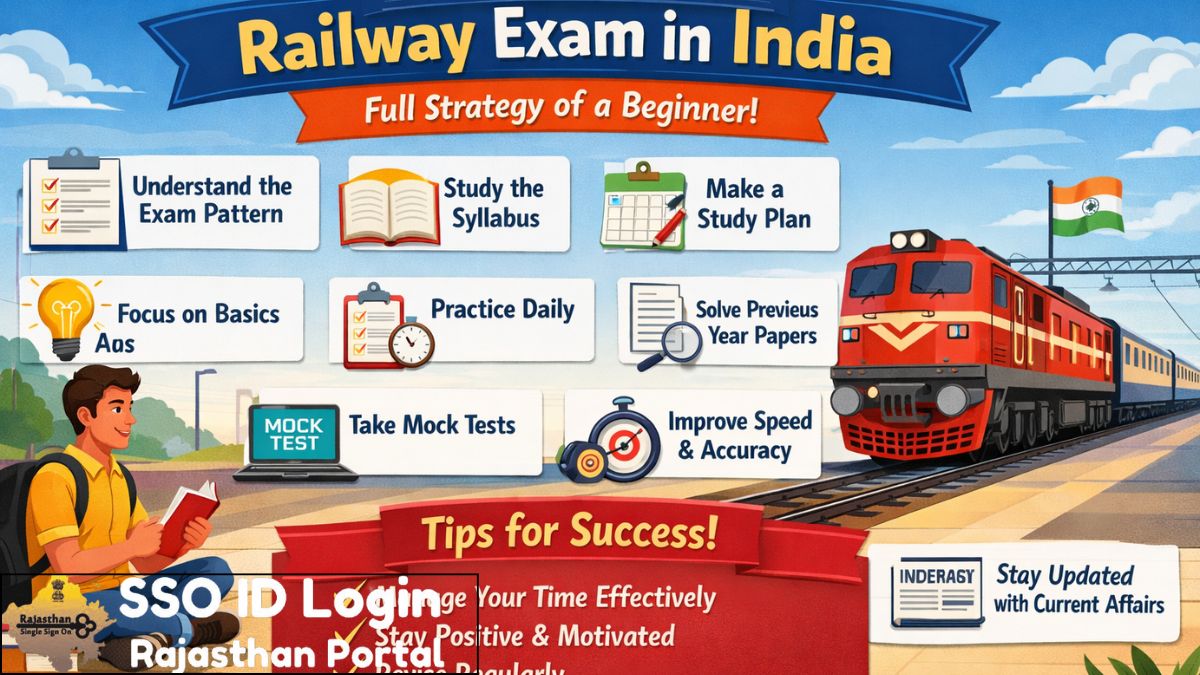
The candidates should be aware of the exam pattern before they begin the preparation. The exams at railways are typically carried out in several phases. The initial step is a computer-based test. There are also some exams that involve physical testing or skill testing based on the job position. The test paper entails objective questions in mathematics, reasoning, general awareness, and general science. In the meantime, applicants have to pass every stage to proceed with the recruitment procedure. Knowledge of exam structure allows candidates to train well.
Familiarity of Railway Exam Syllabus
Railway exams syllabus includes various subjects. Mathematics comprises of arithmetic, percentages, ratios and algebra. In reasoning are puzzles, coding, and questions of a logical nature. General awareness is in form of current affairs, history, geography, and economy. General science incorporates the basics of physics, chemistry and biology. In the meantime, candidates ought not to memorize ideas but ought to work on clarity of concepts.
Creating a Study Plan
The correct examination preparation plan requires a study plan on the railway examination. The candidates ought to break their day into various subjects studying sessions. As an example, it is possible to use the mornings with theory and the evenings with practice. In the meantime, it is easier to include revision time as a way of retaining. Productivity is enhanced by following a systematic routine.
Solving Previous Year Papers
Past year papers are very helpful in the process of exam preparation, as it gathers a lot of insight about the exam pattern, and the level of difficulty of the questions. Through the analysis of such papers, the candidates will be able to know the kind of questions that are commonly posed and how the exam will be organized.
Meanwhile, the larger the number of papers a candidate manages to solve, the faster and more accurate he/she works. The constant practice is useful in time management, as well as minimizing the possibilities of error when taking the real test. It also creates confidence and familiarity with the form of the exam.
In addition, going through past year questions enables the candidates to know key areas and issues that they need to put more focus on. This would make them better prepare and work on their weaknesses, thus giving them the best chance of succeeding.
Confidence is acquired through practice
Taking Mock Tests Regularly Mock tests are significant in the preparation of railway exams. They prepare candidates to sit in actual exams and give them time management. In the meantime, the analysis of the results of mock tests can be used to pinpoint weak points.
On the basis of the test analysis, the candidates can work on their performance
Frequent examinations enhance confidence and lessen the jitters of exams. Improving Time Management Time keeping is extremely crucial when doing exams. The candidates need to know how to answer questions under time constrained conditions. Timed exercises are beneficial in enhancing speed. In the meantime, it is possible to improve the overall score by solving simple questions initially. Good time management is better performance.
Strengthening Weak Areas
There are strengths and weaknesses of every candidate. Recognizing areas of weakness will make the candidates concentrate on areas of weaknesses. Meanwhile, regular and regular practice is also important in the enhancement of weak points. It is possible to build accuracy and confidence through the regular revision, answering mock tests, and practice of various questions. This strategy serves in the long run to help the candidates convert their weaknesses to strengths and improve their performance during the test.
The work on weaknesses enhances performance
Being seen to keep abreast with current affairs. Railway exams include an examination of current affairs. Candidates ought to read the newspapers regularly. In the meantime, regular updates to the current affairs can be beneficial. General awareness is better when the attention is on key events. They should be revised regularly in order to be remembered.
Applying the Right Study Material
It is important to select the appropriate study material. The candidates are supposed to use reputable books and reliable online materials. In the meantime, an excessive number of sources can be confusing. Limited and quality study materials are better to be followed. Unity enhances the comprehension.
Maintaining Consistency
The secret of passing railway exams is in consistency. Applicants are not supposed to have long breaks between studies. Goal setting on a daily basis keeps the progress on track. Practice makes one more confident. Hard work will produce improved outcomes. Avoiding Common Mistakes
Most candidates do wrong things in the preparations
There are some who overlook some subjects and this impacts the total score. Some are theory only and shunning of questions. In the meantime, of not revising, the necessary topics are forgotten. These errors are to be avoided to enhance preparation.
Conclusion
Exams on rail ways offer great career in India. The level of competition is also high, but with appropriate preparation, candidates will achieve success. Candidates can be in a position to enhance their performance by studying the syllabus, performing repetitions and time management. In the meantime, consistency and focus are still relevant to success. Through the proper approach and commitment, candidates are able to pass railway tests and attain government employment.